
California Surgeon General Recognizes Kern County Hospitals for Advancing Maternal Risk Assessment and Strengthening Care During Labor and Delivery
Kern County, CA — California Surgeon General Dr. Diana E. Ramos joined state and maternal health leaders in Bakersfield on October 6 to recognize seven hospitals across Kern County for completing the Obstetric Comorbidity Index (OB-CMI) pilot. The pilot brought Kern County hospitals together around a shared approach to assess maternal risk during labor and delivery and generated lessons that can help inform efforts to strengthen the quality of maternal care across the state.
The Office of the California Surgeon General presented the following hospitals with certificates of appreciation for their participation in the pilot:
- Adventist Health Bakersfield
- Adventist Health Delano
- Adventist Health Hanford
- Adventist Health Reedley
- Bakersfield Memorial
- Mercy Southwest
- Kaiser Permanente Kern County
“We are grateful to the participating hospitals in Kern County that piloted this approach in real-world health care settings and shared their experiences to help inform how we can strengthen maternal care across California,” said California Surgeon General Dr. Diana E. Ramos. “Improving maternal health outcomes takes all of us working together, from patients, families and communities to clinicians, hospitals and health leaders. The completion of this pilot represents an important step in turning the vision of our Maternal Health Blueprint into action.”
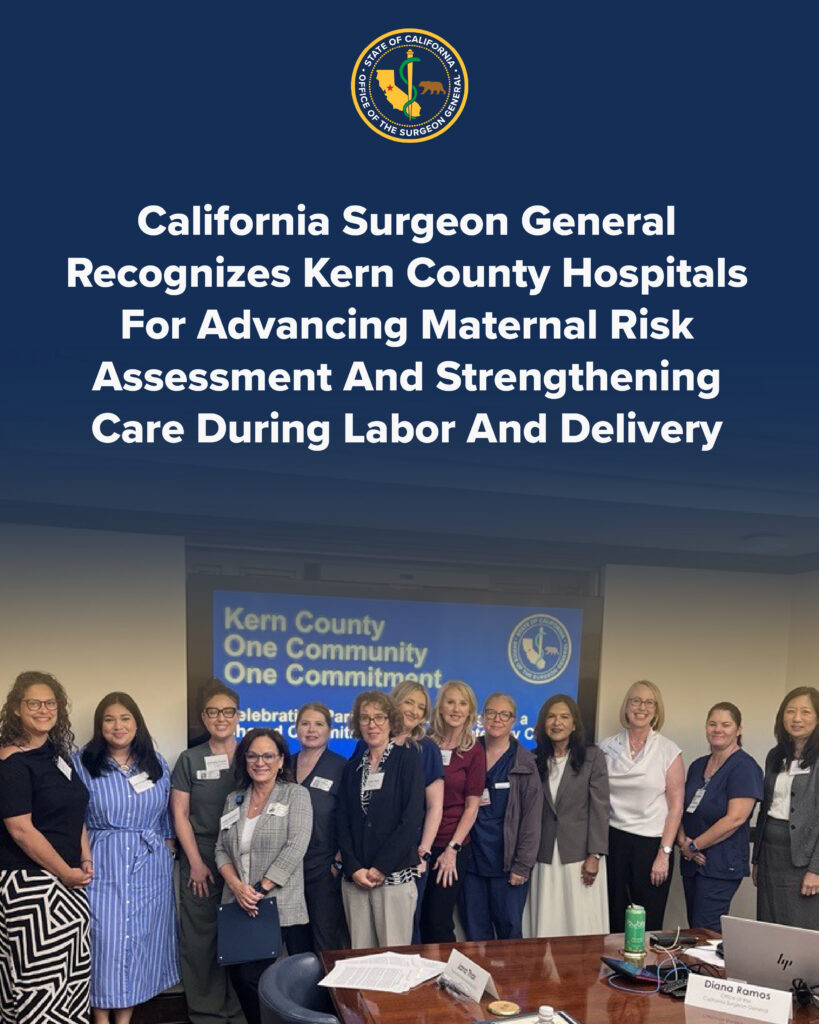
This pilot was part of the California Maternal Health Innovation (California MHI) grant and insights from the pilot will help advance risk assessment across the state. The California MHI, co-led by the Office of the California Surgeon General, California Maternal Quality Care Collaborative (CMQCC), Department of Health Care Services (DHCS) and California Department of Public Health (CDPH), uses a collective impact approach to improve maternal outcomes at the level of health care systems.
From the Maternal Health Blueprint to Action
The Kern County pilot advances a call to action in California’s Maternal Health Blueprint to use the evidence-based, validated OB-CMI to help establish a medical maternal risk standard of care in California health care settings. Developed by Dr. Brian Bateman, the OB-CMI is designed to help health care teams assess a patient’s risk for complications when she arrives for labor and delivery. This information can help inform clinical decision-making and support consideration of the level of care and resources that may be most appropriate for each patient.
Kern County was selected for the pilot in part because of its location in the Central Valley, a region participating in the California Transforming Maternal Health (TMaH) Model. The county also offered a valuable learning environment with hospitals representing a range of labor and delivery volumes. This diversity provided an opportunity to explore how the OB-CMI could be used in different hospital settings and generate insights to inform future efforts. Learning from hospitals with different patient volumes and care settings can help identify opportunities to strengthen risk assessment, support more consistent care and address gaps in maternal health outcomes.
“Every pregnancy carries unique health considerations, and timely identification of risk is critical to ensuring patients receive the right care at the right time,” said Dr. Karen Mark, Medical Director for the California Department of Health Care Services (DHCS). “The Kern County hospitals that participated in this pilot demonstrated a strong commitment to advancing evidence-based maternal care and improving outcomes for birthing people and their babies. By testing the Obstetric Comorbidity Index in real-world settings, these clinical teams have generated valuable lessons that will help inform maternal quality improvement efforts across California and support our ongoing work to reduce preventable complications and promote healthier pregnancies and births for all Californians.”
“This pilot provides valuable insight into how evidence-based tools like the OMI can support more consistent, equitable, and high-quality care across settings,” said Dr. Rita Nguyen, California’s Assistant Public Health Officer. “CDPH Maternal, Child & Adolescent Health Division will continue working alongside partners to advance quality improvement efforts that help ensure all birthing people receive the care and support they need.”
Building on Lessons Learned in Kern County
The completed pilot is a first step in a broader effort to apply lessons learned in Kern County to maternal quality improvement across California. The findings will inform ongoing work by the CMQCC, in partnership with DHCS and CDPH.
Rather than creating a separate process, CMQCC will leverage the findings to help determine how the OB-CMI can be woven into existing quality improvement efforts. These lessons will help shape approaches to maternal risk assessment and care during labor and delivery, with the goal of supporting more consistent, appropriate care across different hospital settings.
As this work progresses, the experience in Kern County can help inform how the OB-CMI is incorporated into quality improvement efforts more broadly, supporting California’s continued work to close gaps in maternal health outcomes and improve care for mothers and families throughout the state.
“Our shared vision is for patients and families to always receive the care they need, whether they’re delivering at a hospital, seeking care in their community, or accessing public health services,” said CMQCC Executive Director Leslie Kowalewski. “The important lessons contributed by the hospitals in Kern County will help CMQCC and California MHI support providers, teams and systems in different settings as they begin to use the OMI to assess risk and determine the right care. Through our ongoing collaborations, we will continue to improve high-quality, positive care experiences for all maternal patients in California.”
The Kern County pilot reflects the collaborative approach at the heart of California’s maternal health efforts: bringing hospitals, clinicians and state partners together to test evidence-based approaches, learn from real-world experience and translate those lessons into stronger maternal care for Californians.
Bigger Picture
The Office of the California Surgeon General launched the Strong Start & Beyond movement to reduce maternal mortality, educate and empower individuals of reproductive age and save the lives of moms and pregnant people in California. Although California has the lowest maternal mortality rate in the nation, the movement builds on other statewide efforts to continue improving reproductive and maternal health outcomes across the state, including the First Partner, CDPH’s Maternal, Child and Adolescent Health Division (Perinatal Equity Initiative, Black Infant Health, Home Visiting Program, and more), and DHCS’ Birthing Care Pathway and TMaH model.